PSP
PSP Specifications
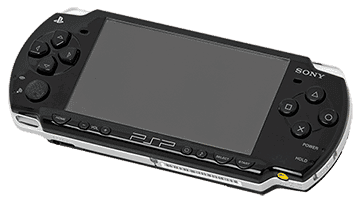
The PlayStation Portable (PSP) was Sony’s first handheld console and its attempt to challenge Nintendo’s dominance of the handheld market. The PSP was well regarded and benefited from the strength of the PlayStation brand, but it fell well short of its main competitor, the Nintendo DS. The PSP sold over 80 million units over its roughly ten-year lifespan, a respectable figure but far below the DS family’s roughly 154 million.
PSP emulation began not long after the console’s release in 2004. The first attempt was PSPE, which could never run a commercial game but showed that PSP emulation was possible. Many other emulators followed. The leading PSP emulator today is PPSSPP, which can run almost every PSP game and render it in HD. Thanks largely to the PPSSPP team, PSP emulation is now very mature.
The PSP had high-end hardware for its time, with a more powerful processor and GPU than the Nintendo DS. It also had multimedia features such as video and music playback, and it could connect to the PlayStation 3 for Remote Play.
Unlike Nintendo’s handhelds and most of the rivals that tried to compete with them, the PSP used an optical disc format instead of cartridges: the Universal Media Disc (UMD).
Advertisement
PSP Emulators

PPSSPP is a fast, open source PSP emulator that runs almost every PSP game in HD on Windows, macOS, Linux, Android and iOS.

JPCSP is a PSP emulator written in Java for Windows, Linux and macOS. Despite Java's overhead, it runs a number of commercial games at full speed.
PCSP is an early PSP emulator for Windows written in C++. It can run some homebrew but no commercial games, and development has stopped.
Soywiz PSP Emu is an abandoned PSP emulator written in C# for Windows and Linux. It ran several commercial games at a decent speed.